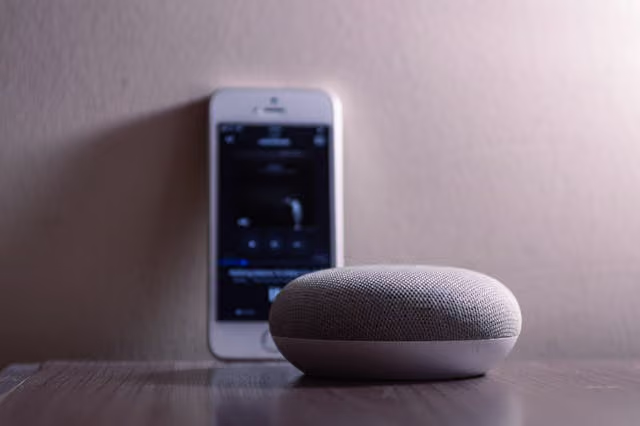
A phone and a small speaker on a counter top

AI Call Monitoring Lawsuits | TCPA & Wiretap Violations

The consumer privacy lawyers at The Lyon Firm are investigating a range of personal privacy violations involving new software that provides AI robocall and AI call monitoring services. Some new AI TCPA lawsuits have been filed on behalf of plaintiffs nationwide following privacy intrusions. Contact The Lyon Firm to learn more about AI call monitoring that may violate existing wiretapping laws.

AI Call Monitoring: Legal Risks and Compliance Considerations

Artificial intelligence is transforming how businesses interact with customers, and one of the fastest-growing applications is AI-powered call monitoring. Companies are increasingly relying on AI tools to record, transcribe, and analyze customer service calls, sales conversations, and internal communications. While these technologies can improve efficiency, compliance, and customer experience, they also raise significant legal and privacy concerns.

What Is AI Call Monitoring?

AI call monitoring involves the use of machine learning and natural language processing (NLP) to automatically review phone conversations. These systems can flag potential compliance violations, detect fraud, evaluate employee performance, and even measure customer sentiment. Unlike traditional recording systems, AI platforms often analyze calls in real-time, drawing insights from tone, keywords, and conversation patterns.

Is AI Call Monitoring Legal?

In short, yes, AI call monitoring is legal. However, companies who engage in any call monitoring are subject to some legal considerations concerning personal privacy, transparency, and prior consent.

Many telemarketing companies are now using AI software to record or monitor customer calls, which must adhere to federal and state wiretapping laws, which vary in their respective consent requirements. Federal law requires only one-party consent (one party knows and agrees to the recording), but some states, such as California (CIPA), Delaware, Florida, Illinois, Maryland, Massachusetts, Montana, Nevada, New Hampshire, Pennsylvania, and Washington, require two-party consent, which means everyone on the call must consent to the recording or monitoring.

Key Legal Issues With AI Call Monitoring

Although businesses see great value in AI call monitoring, the practice is heavily regulated. Several legal risks arise when companies monitor and record conversations:

1. Consent and Wiretap Laws

Federal and state wiretap laws require proper consent before recording or monitoring phone calls. Under the federal Wiretap Act, at least one party must consent. However, several states—including California, Florida, Illinois, and Pennsylvania—require two-party (or all-party) consent, meaning every participant must be informed. Failing to obtain consent can lead to civil lawsuits, statutory damages, and criminal penalties.

AI adds complexity to this issue. If a business is using AI tools that not only record but analyze conversations, courts may consider whether such analysis constitutes a “second listener” requiring additional disclosures.

2. Data Privacy and Security

AI call monitoring often involves collecting sensitive personal information such as financial details, health information, or biometric data (like voiceprints). This triggers obligations under privacy laws such as:

  • California Consumer Privacy Act (CCPA) and the California Privacy Rights Act (CPRA)

  • General Data Protection Regulation (GDPR) in the EU

  • Health Insurance Portability and Accountability Act (HIPAA) if health data is involved

Companies must ensure secure storage, limited data retention, and proper notice to consumers about how their data is used.

3. Employment Law Concerns

When employers use AI to monitor employee calls, workplace privacy rights come into play. Courts may scrutinize whether employees had a “reasonable expectation of privacy,” and whether the employer’s practices are transparent, nondiscriminatory, and compliant with state labor laws.

4. AI Bias and Discrimination

AI systems are only as unbiased as the data they are trained on. If monitoring tools are used in hiring, promotions, or performance evaluations, companies may face discrimination claims if the AI produces biased outcomes against certain groups of employees or customers.

Cell Phone

It is important for businesses using AI-generated voices, AI recording devices or call monitoring to disclose that to the consumer, as required by regulations like the TCPA. The Telephone Consumer Protection Act (TCPA) classifies AI-generated voice calls as “robocalls,” requiring businesses to obtain prior express written consent before making marketing or promotional calls. TCPA laws and wiretapping laws have been cited in some AI call monitoring lawsuits, such as the following:

  • Dialpad, an AI analytics software provider, is facing a class action lawsuit for allegedly recording and using customer calls to train AI models in violation of California privacy law. The class action attorneys claim the company has illegally wiretapped and recorded the private conversations of consumers who called the T-Mobile customer support line. Although the callers were informed that the calls may be recorded, they were not told their conversations would be shared with a third party.
  • The Galanter v. Cresta Intelligence lawsuit alleges that the AI vendor, Cresta, recorded, transcribed, and analyzed a customer’s call without proper knowledge or consent, violating California’s CIPA law.
  • The Navy Federal Credit Union Lawsuit questions the use of AI call recording technology to record and analyze phone calls without customers’ knowledge or consent.

Why Hire The Lyon Firm For AI Call Monitoring Cases?

The Lyon Firm has extensive experience in TCPA litigation, consumer privacy law, and class action lawsuits. We have represented thousands of clients in privacy-related cases and understand how to build wiretap and TCPA class actions against both the companies deploying AI tools and the vendors supplying them.

These cases are often well-suited for class treatment because the same AI system may have been used to record hundreds of thousands of calls under the same disclosure practices. That means your individual experience may reflect a systemic violation affecting a large number of people, which is exactly the kind of case class action law was designed to address.

We handle these cases on contingency. No fees or costs until we recover on your behalf. If you believe your calls were recorded or monitored by AI without proper consent, contact The Lyon Firm today for a free consultation. We represent clients in California, Ohio, Illinois, Florida, and all fifty states.

Who May Have a Claim?

You may have a viable legal claim if:

  • You received an AI-generated robocall without having given prior written consent
  • You were recorded during a customer service, sales, or support call and not told that the recording would be processed by a third-party AI platform
  • You are an employee whose workplace calls were monitored by an AI system without clear disclosure or your agreement
  • You live in a two-party consent state and were recorded without everyone on the call being informed

Frequently Asked Questions

Is it legal for a company to record calls using AI? It can be legal, but only with proper consent. Federal law requires one-party consent. Many states including California, Illinois, and Florida require all-party consent, meaning everyone on the call must be informed. If proper consent was not obtained, the recording may be unlawful.

What are TCPA damages for AI robocalls? TCPA violations can result in statutory damages of $500 per call, increasing to $1,500 per call for willful violations. In a class action with thousands of calls, total liability can be substantial.

Can I sue if an AI vendor analyzed my call without my knowledge? Potentially yes, particularly in California and other all-party consent states. Courts have found that sharing call recordings with third-party AI platforms for analysis may require additional disclosures beyond a basic recording notice.

CONTACT THE LYON FIRM TODAY

Please complete the form below for a FREE consultation.

  • This field is for validation purposes and should be left unchanged.