Toledo Chemical Spill Investigation
October 22, 2026


BIPA Lawsuit Compensation ranges from $1,000-$5,000 per violation. Contact The Lyon Firm today for a free voiceprint privacy violation case review. We have been filing BIPA cases for years and we have the experience to take your case the distance. Call now for a free consultation.
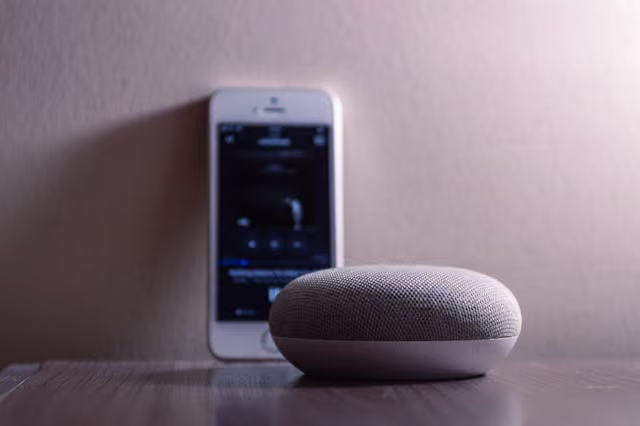
Every time you call customer service and interact with a voice assistant, your voice may be creating a digital trail for companies capturing and storing unique voiceprints, often without your knowledge or permission. This practice has sparked a surge of BIPA lawsuits (Illinois Biometric Information Privacy Act violations) that could entitle millions of Americans to voiceprint settlement compensation.
Recent voiceprint privacy lawsuits have exposed how companies illegally collect voice biometric data without consent. If you're an Illinois resident or were physically in Illinois when these companies recorded your voice, you may be entitled to join a voiceprint class action lawsuit seeking damages of up to $5,000 per violation.
Sophisticated algorithms analyze your speech patterns and extract unique characteristics including vocal pitch, cadence, tone, rhythm, and timbre. These distinctive features combine to create a biometric signature that identifies you as reliably as a fingerprint scanner or facial recognition system. Companies that deploy voice recognition systems are often in violation of Illinois BIPA.
Companies utilize these biometric voice profiles for speaker identification, security verification, automated transcription attribution, and customer authentication.
The Illinois Biometric Information Privacy Act stands as America's most powerful consumer protection statute governing biometric data collection. Enacted in 2008, BIPA recognizes that biometric identifiers present serious privacy risks because individuals cannot change their biological characteristics once compromised.
BIPA establishes four fundamental requirements that companies must satisfy before collecting any biometric identifier, including voiceprints:
The statute grants individuals a private right of action, enabling consumers to file lawsuits directly against violators.

Biometric identifiers differ from traditional personal information because they are derived from immutable physical characteristics. The biometric signature extracted from your vocal patterns remains permanently compromised, creating lasting vulnerability to identity theft and fraudulent authentication.
Companies collecting voiceprints without informed consent deprive individuals of a choice about whether to share these highly sensitive identifiers. Many consumers have no idea their voices are being analyzed for biometric extraction during ordinary business interactions.
The unauthorized collection of voiceprints also enables pervasive surveillance and tracking capabilities that many individuals would reject if given genuine choice. Voice biometrics allow organizations to identify and track individuals across multiple interactions without requiring traditional identifiers like names or account numbers.
Illinois law provides $1,000 per negligent violation and $5,000 per intentional or reckless violation. If a company collected your voiceprint multiple times, you may be entitled to multiple violations worth thousands in total compensation. Contact The Lyon Firm to calculate your potential voiceprint settlement amount.
Individuals may have viable claims if they interacted with voice recognition technology while residing in Illinois or while physically present in the state.
The main question is whether the company obtained your informed written consent before collecting your voiceprint. Simply clicking "I agree" to general terms of service typically does not satisfy BIPA's stringent consent requirements. The statute demands specific written disclosures explaining that biometric data will be collected and how long the information will be retained.
The Illinois Supreme Court has established a five-year statute of limitations for BIPA claims, providing a wide window for bringing legal action. Even individuals who no longer use the technology or no longer reside in Illinois may qualify for class membership based on their past Illinois residency and historical use of the systems.

Participating in a voiceprint privacy class action or mass arbitration involves minimal time commitment and no upfront costs. Attorneys handling these matters work on contingency, receiving payment only from any settlement or judgment recovered.
Class members typically need only to provide basic information confirming their Illinois connection and use of the relevant technology. Named class representatives may participate in depositions and court proceedings, but most class members simply wait for updates as the litigation progresses.
If you suspect a company has collected your voiceprint without proper consent, document your interactions with the technology.
Don't let companies profit from your biometric data without consequence. Call The Lyon Firm for a free voiceprint lawsuit case review. No fees unless we win your case.
The Lyon Firm has established itself as a leader in biometric privacy litigation, combining technical understanding with aggressive legal advocacy. Our attorneys stay current with the rapidly evolving landscape of BIPA jurisprudence and legislative amendments that affect our clients' rights.
Contact The Lyon Firm today for a free, confidential consultation about your voiceprint privacy claim. Our attorneys will explain your legal options and help you understand the potential compensation you may be owed.
The Lyon Firm is a Cincinnati, Ohio-based law firm, representing individuals nationwide in class action, product liability, and toxic exposure litigation.

Taking the first step doesn’t have to be complicated. In just a few minutes, you can share the basics of your case, and our team will guide you from there: