FTC Warns Healthcare Companies on Facility Fee Pricing
October 8, 2026


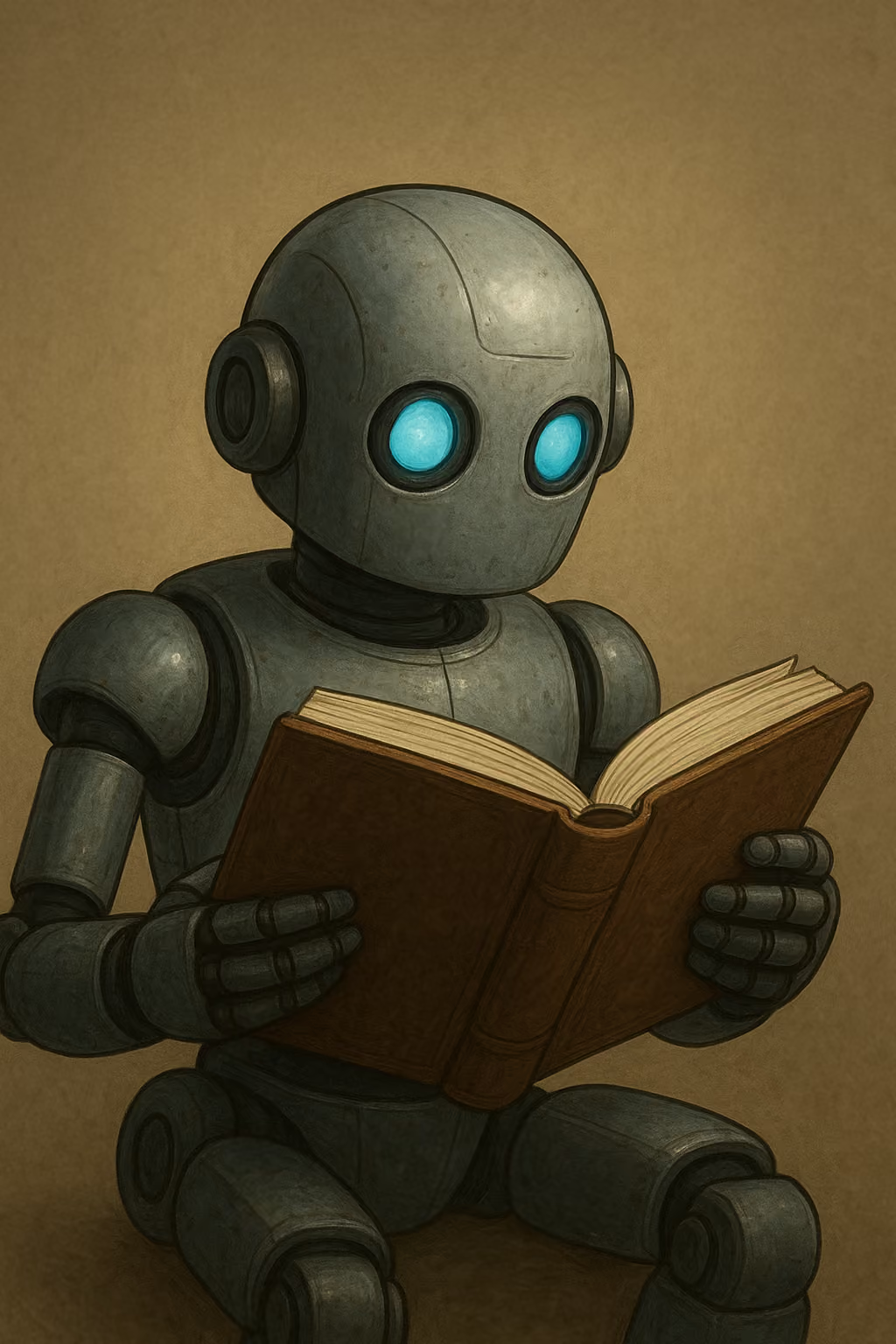
Anthropic, the company behind the Claude chatbot, has agreed to a $1.5 billion settlement with authors and publishers who alleged that their copyrighted works were used without permission to train the company’s large language models.
The agreement represents one of the largest copyright settlements in U.S. history and is likely to influence how future lawsuits and regulations address AI training data.
For years, AI developers have relied on vast datasets, scraped from the internet or sourced from libraries, to train systems that now power multibillion-dollar businesses. The Anthropic settlement shows that this approach carries not only ethical questions but also enormous financial and legal risks.
Authors alleged that Anthropic had copied hundreds of thousands of books from online “pirate” repositories such as Library Genesis and Pirate Library Mirror. The company then used those works to train Claude, one of the industry’s leading generative AI models.
As part of the settlement, affected authors are set to receive about $3,000 per book. Anthropic has also agreed to remove and destroy the infringing files, an acknowledgment that how training data is acquired matters.
Although the company did not admit liability, the financial terms speak to the seriousness of the claims. The settlement reflects a belief that creators’ intellectual property cannot, without consequence, be treated as raw feed for technological innovation.
One of the interesting aspects of this case is its treatment of “fair use.” Courts have long held that certain types of copying for education or research may be permissible. AI companies have argued that training a model is fair use because it is transformative. This can be argued because the machine does not deliver exact copies of the original work but instead generates new text.
The court seemed to agree that training on legally obtained materials might fall under fair use, but downloading pirated copies does not. The court distinguished between legitimate data acquisition and wholesale copying from illegal repositories.
The size of the settlement sends a message that the practice of mass scraping or relying on pirate datasets can no longer be dismissed as a cost-free shortcut. Companies will now face pressure to prove that their training data was lawfully acquired, through licensing agreements or public-domain sources.
Similar lawsuits are underway, filed against other AI leaders, including OpenAI and Meta. These cases involve authors and software developers who argue that their work was used without permission.
Warner Bros. and other studios have challenged Midjourney over image generation trained on copyrighted film characters. And, major record labels have sued AI music platforms such as Suno and Udio, alleging infringement of sound recordings.
Some AI companies are proactively striking licensing deals with publishers and record labels. Others continue to defend fair use claims in court.
By combining claims from hundreds of thousands of rights holders in a class action, the lawsuit gained attention that individual authors could never have achieved alone. The class structure allowed for uniform per-work compensation and broader systemic remedies, including the destruction of infringing datasets.
This model may become standard for creators across industries, as musicians and filmmakers are already exploring collective strategies to confront AI companies. The Anthropic case demonstrates that such class actions can successfully challenge corporate behavior.
How can I know if my work was used to train an AI system?
Lawyers and experts may analyze datasets or review company disclosures obtained in litigation. Some online tools can provide indications, but solid proof often requires professional analysis.
What damages are available in these cases?
Copyright law allows for recovery of statutory damages up to $150,000 per work for willful infringement and injunctions. The Anthropic settlement’s $3,000 per book figure was a negotiated resolution.
Do I need to join a class action?
Both class actions and individual lawsuits are possible. Class actions give creators strength in numbers and shared costs, while individual cases may allow for more tailored claims.
How long do I have to file?
Copyright claims generally must be brought within three years of discovering the infringement.
The Lyon Firm is a Cincinnati, Ohio-based law firm, representing individuals nationwide in class action, product liability, and toxic exposure litigation.
Taking the first step doesn’t have to be complicated. In just a few minutes, you can share the basics of your case, and our team will guide you from there: